¿Qué es el ABS?
Al igual que el PC, ABS es una abreviatura estándar y de uso común en el campo de los materiales poliméricos. Se refiere fundamentalmente al copolímero de acrilonitrilo-butadieno-estireno (Acrilonitrilo Butadieno Estireno, en español), un plástico ingenieril de uso general que se obtiene por copolimerización de tres monómeros: acrilonitrilo (AN), butadieno (BD) y estireno (ST).
Sus propiedades se pueden adaptar con precisión al modificar la proporción de estos tres componentes, lo que lo convierte en una de las variedades de plástico más utilizadas tanto en la industria como en la vida cotidiana.
Propiedades clave resumidas
- Mecánicas: Alta resistencia, tenacidad y rigidez, con buena performance de impacto a baja temperatura.
- Procesamiento: Fácil de moldear por inyección, extruir y termoformar; su superficie admite galvanoplastia, pulverización y serigrafía.
- Químicas: Resistente al agua, sales inorgánicas y álcalis, pero sensible a solventes fuertes (acetona, hidrocarburos aromáticos).
- Otros: No tóxico (grado alimentario requiere certificación), buena estabilidad dimensional y costo moderado.
Aplicaciones típicas
Carcasas de electrodomésticos (televisores, refrigeradores, lavadoras), piezas interiores y exteriores de automóviles, gabinetes de equipos electrónicos, juguetes (ladrillos Lego), tuberías, láminas y útiles de oficina.
¿Necesito ayudarte a redactar esta definición de ABS en un formato de ficha técnica concisa o una versión en inglés para exportación?
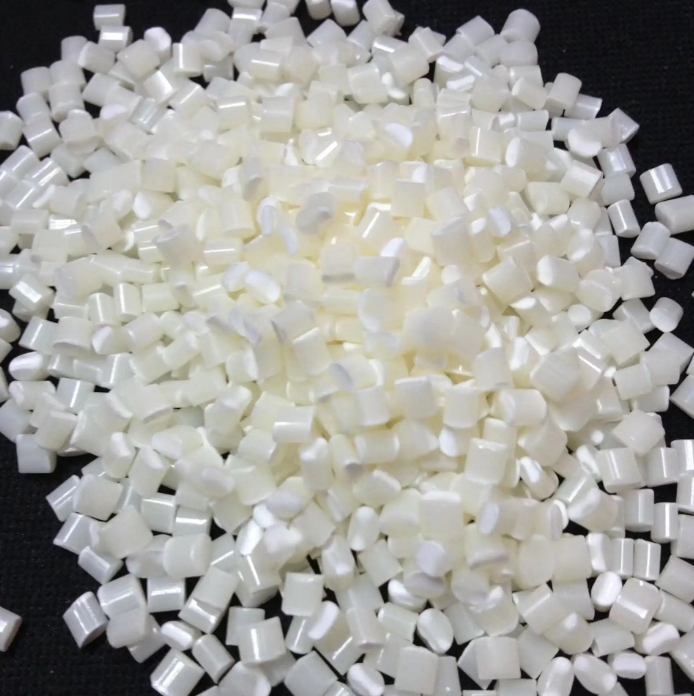
Core Properties and Production Process of ABS
-
Raw Material Sources
All three monomers are petroleum-based chemicals (acrylonitrile derived from propylene oxidation, butadiene from petroleum cracking, and styrene from alkylation of benzene and ethylene), rendering ABS a typical petroleum-based plastic. Currently, there are no fully bio-based ABS products in large-scale application, but some enterprises are developing alternative raw materials like bio-based styrene to improve its sustainability.
-
Production Process
The mainstream industrial process is the
compound process of emulsion graft copolymerization + bulk copolymerization, consisting of two core steps: first, emulsion graft copolymerization of butadiene rubber latex with acrylonitrile and styrene to produce graft copolymers containing rubber particles (to enhance material toughness); second, blending and pelletizing the graft copolymers with styrene-acrylonitrile copolymer (SAN, to improve rigidity and heat resistance) to obtain final ABS products. Besides, suspension copolymerization and bulk copolymerization are also available for products with different performance requirements. Subsequent secondary processes including extrusion, injection molding, thermoforming and electroplating can turn it into various finished products.
-
Key Properties
Its core advantages are
balanced rigidity & toughness, easy processability and high cost-effectiveness, with the three monomers complementing each other in properties: acrylonitrile endows it with excellent chemical resistance, surface hardness and heat resistance; butadiene provides high toughness and impact resistance (its low-temperature impact performance is superior to ordinary plastics); styrene offers good processing fluidity, transparency and surface gloss. Its heat deflection temperature is about 90–110℃, enabling stable dimensional performance over a wide temperature range. Its main drawback is poor weather resistance (prone to aging, yellowing and performance degradation when exposed to sunlight for long periods), which can be optimized by adding antioxidants, ultraviolet absorbers or via blending modification (e.g., ABS/PC alloy).
-
Application Scenarios
ABS is widely used in home appliances, automotive, electronics & electricals, construction and daily necessities, such as home appliance housings (refrigerators, washing machines, air conditioners, TVs), automotive interior parts (instrument panels, door panels, armrests), electronic device housings (keyboards, mice, printers), pipes & fittings, toys (Lego bricks) and suitcases. It is especially suitable for scenarios requiring balanced rigidity and toughness with cost sensitivity.
Core Differences Among ABS, PC, PEL, PAL and PL (Polylactic Acid)
Among the five materials, ABS and PC are standard universal abbreviations and mainly petroleum-based; PEL, PAL and PL are positioned as core bio-based materials, with significant differences in molecular structure, performance focus and application scenarios, detailed as follows:
- Molecular Structure & Raw Material Differences
- ABS: Terpolymer structure of acrylonitrile-butadiene-styrene in the main chain, fully petroleum-based raw materials.
- PC: Repeating carbonate groups in the main chain, mainstream raw materials are petroleum-based (bisphenol A + phosgene).
- PL (Polylactic Acid): Repeating ester bonds in the main chain, fully bio-based raw materials (corn, cassava, etc.).
- PEL: Repeating ester bonds in the main chain, polyester elastomer structure, available with bio-based raw materials.
- PAL: Main chain composed of amide bonds (rigid segments) + elastomer segments (flexible segments), copolymer structure, mainly bio-based raw materials.
- Performance Focus Differences
- ABS: Core strengths—balanced rigidity & toughness, easy processability and high cost-effectiveness; poor weather resistance, non-biodegradable.
- PC: Core strengths—high impact strength, high transparency and good heat resistance; balanced rigidity & toughness, light transmittance far superior to ABS; non-biodegradable (traditional grades).
- PL: Core strengths—full biodegradability and good processability; moderate rigidity, no elasticity, poor heat resistance (55–60℃).
- PEL: Core strengths—high elasticity and degradability; optimal elastic recovery rate, weakest rigidity.
- PAL: Core strength—balanced rigidity & elasticity; higher strength and wear resistance than PEL, better elasticity than bio-based nylon.
- Application Scenario Differences
- ABS: Suitable for structural parts requiring balanced rigidity & toughness and high cost-effectiveness (home appliance housings, automotive interiors, toys).
- PC: Suitable for structural/functional parts requiring high strength, transparency and heat resistance (electronic housings, automotive lamp shades, medical devices).
- PL: Suitable for disposable eco-friendly products and packaging materials (biodegradable scenarios without elasticity requirements).
- PEL: Suitable for eco-friendly scenarios requiring high elasticity (degradable elastic packaging films, biomedical elastic components).
- PAL: Suitable for eco-friendly scenarios requiring both strength and elasticity (automotive elastic structural parts, high-end stretch fabrics).